|
|
 |
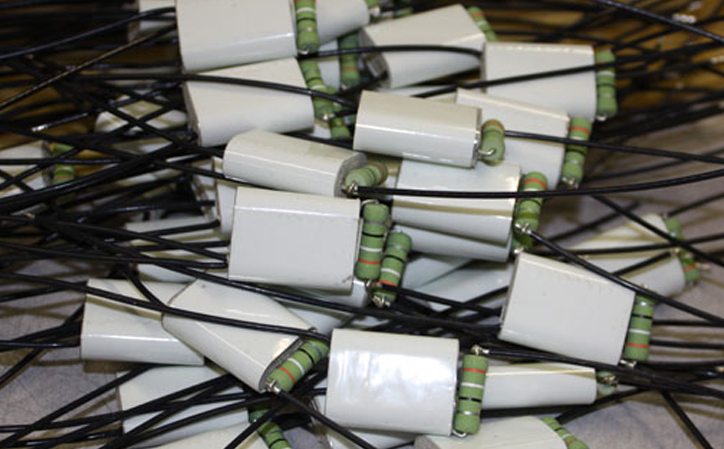
Snubber CapacitorsSeries RC1313 Resistor-Capacitor Networks
Applications |
Recommendations
Resistor & Lead Specifications |
Diagram |
Dimensions & Ratings Table
Series RC1313 Catalog Nomenclature
Series RC1313 PDF Download
Applications
Noise suppression and Contact protection
The circuit to be used is dependent upon particular situations. Either circuit may be enough protection for your needs. For extreme situations, both "Load" and "Contact" protection may be required.
Recommendations
There are two types of discharges that can damage switching contacts and generate noise:
- "Glow Discharges" caused by the ignition of gases between contacts. These develop at about 320 volts at about a 0.0003 inch gap range and can be sustained at a much wider gap range.
- "Arc Discharges" occur at much lower voltages, about 0.5 MV/cm. Minimum voltages and currents are necessary for "Arc Discharges" to be sustained. Contact material also plays a role in sustained "Arc Discharges". (see Table 1)
| MATERIAL |
MIN. VA Arcing Voltage |
MIN. IA Arcing Current mA |
Silver Gold Gold Alloy Palladium Platinum |
12.0 15.0 19.0 16.0 17.5 |
400 400 400 800 700 |
Table 1
The function of the RC network is to:
- Keep the voltage across the contacts below 300 volts. C ³ (IL/300)2L
- Keep the rate of voltage change below 1 V/ms. C ³ ILx10-6
- Keep the current below that described in Table 1.
Inductors do not instantly "let go" of a current. At the instant a contact opens, the current through the contact does not want to change. Using Ohm's Law (E = IR), we can see that when the contact is closed, the resistance is essentially zero, making the voltage zero as well. As the contact opens the resistance begins to increase. This leads to the generation of a high voltage which is generally destructive to contact life.
Capacitors will restrict an instantaneous change in voltage. A capacitor, therefore, is useful to counter the destructive voltages generated at the switch contacts. When the contacts are closed, the capacitor is out of the circuit. As the contacts are opened any change in voltage is restricted by the capacitor if its value is large enough to restrict the voltage change to less than 1 V/ms.
A capacitor alone is not an ideal solution. When the contacts are open, the capacitor charges up to the supply voltage. As the contact is "made", an inrush of current results, limited only by a residual resistance, and damage may still result. For this reason, a resistor is configured in series with the capacitor. The higher the resistance value, the smaller the inrush current and the less effective is the capacitor. The voltage across the contacts when opened is equal to the load current x resistance (V = IR). It is recommended to keep V £ supply voltage. In this case, the maximum resistance of the network (RN) will be equal to the load resistance (RL).
The above formulas are recommended for determining the RC network parameters. They do not identify all of the subtleties but should serve as a guideline for effective results.
| Resistor Specifications |
 |
Lead Specifications |
Power (Watts) |
Voltage (VAC) |
Type |
0.25 0.50 |
250 250 |
Carbon Comp. Carbon Comp. |
Resistor Tolerance: ± 10% or better
|
|
| Solid Copperweld |
| L |
S |
Dia. |
Min. Lead Length |
0.709 1.040 1.260 |
0.562 0.886 1.130 |
.031 .031 .031 |
1.000 1.000 1.000 |
|
All dimensions in inches
Dimensions and Ratings
| RC1313 |
Cap. mF |
Voltage DC AC |
Res. Value W |
L in. (mm) |
T in. (mm) |
H in. (mm) |
Size Code |
UL-Recognized Part |
0.10 0.10 |
200 630 |
125 250 |
22-1000 22-1000 |
.709 (18.0) 1.040 (26.5) |
.295 (17.5) .335 (18.5) |
.531 (13.5) .669 (17.0) |
H N |
Ö |
0.25 0.25 |
200 630 |
125 250 |
22-1000 22-1000 |
.709 (18.0) 1.040 (26.5) |
.295 (17.5) .394 (10.0) |
.531 (13.5) .748 (19.0) |
H O |
|
0.50 0.50 |
200 630 |
125 250 |
22-1000 22-1000 |
1.040 (26.5) 1.260 (32.0) |
.236 (16.0) .512 (13.0) |
.591 (15.0) .866 (22.0) |
L Q |
|
1.00 1.00 |
200 630 |
125 250 |
22-1000 22-1000 |
1.260 (32.0) 1.260 (32.0) |
.335 (18.5) .670 (17.0) |
.669 (17.0) 1.360 (34.5) |
N V |
Ö |
EFC will manufacture to any non-standard value and size. Please consult factory for special requirements.
RC1313 Catalog Nomenclature
| RC |
1313 |
EFR |
-0N |
-0.1 |
-06.3 |
-020 |
/ |
5 |
101 |
- Application Option
- RC - R/C Network
- Dielectric Code
- 1313 - Metallized Polyester
- Case Code
- EFR - Epoxy Case - Flat - Radial
- Size Code
- See Dimensions and Ratings Table
- Capacitance (mF)
- See Dimensions and Ratings Table
- Voltage
- 2.0 - 200
VDC
- 4.0 - 400
VDC
- 6.3 - 630 VDC
|
 |
- Capacitance Tolerance
- 05 - ± 05%
- 10 - ± 10%
- 20 - ± 20%
- etc.
- Resistor Wattage
- 2 - 1/4 watt
- 5 - 1/2 watt
- 6 - 1.0 watt
- 7 - 2.0 watt
- Resistor Value (W)
- First 2 digits are significant figures,
last digit is number of zeroes added
- (i.e. 101 = 100 ohms)
|
EFC will manufacture to any non-standard value and size. Please
consult factory for special requirements.
Snubber-Power Capacitors
Series 1206 |
Series 1213 |
Series 1306 |
Series 1313 |
Series 1613 |
Series 1906
Catalog |
Catalog Nomenclature |
Specification Summary |
Dielectric Properties
Search
About EFC |
Factory Tour |
Contact Us |
Representatives & Distributors |
Home
 |
| Electronic Film Capacitors, Inc. d/b/a EFC/Wesco |
Reidville Industrial
Park 41 Interstate Lane Waterbury, CT 06705 |
 |
Telephone: (203)
755-5629 Fax: (203) 755-0659 Email: efc@filmcapacitors.com |
 |
Copyright © 1998, 1999, 2000, 2007,
2008 Electronic Film Capacitors, Inc. d/b/a EFC/Wesco |
|
|